16 Apr 2026
By Richard Muir, Deputy Chief Executive of Glasgow Chamber of Commerce.
If the New York leg of the trade visit was about pace, positioning and celebrating all things Scottish including our businesses and brands, Pittsburgh has been about depth, collaboration, and what a truly connected innovation ecosystem looks like in practice in a smaller but still mighty city. I was told that the ‘bones of Pittsburgh are Scottish’ with such leading lights as Andrew Carnegie, the Scottish born industrialist who built his steel empire in Pittsburgh plus others including Margaret Fay Shaw, James Gourlay and Brigadier General John Forbes, a Scottish soldier who established Fort Pitt in 1758, renaming the settlement Pittsburgh. The love for Glasgow goes back a long way in Pittsburgh.
Our Global Glaswegian Neil Owen put together a brilliantly packed 2 day programme and from the outset it was clear this is a city that shares many similarities with Glasgow and it has deliberately reinvented itself from its days as the steel and heavy industry capital of the USA. Today, Pittsburgh is a global benchmark for how to transition into a knowledge-led, innovation-driven economy - and importantly, how to do that in a way that brings institutions, industry and government into genuine alignment.
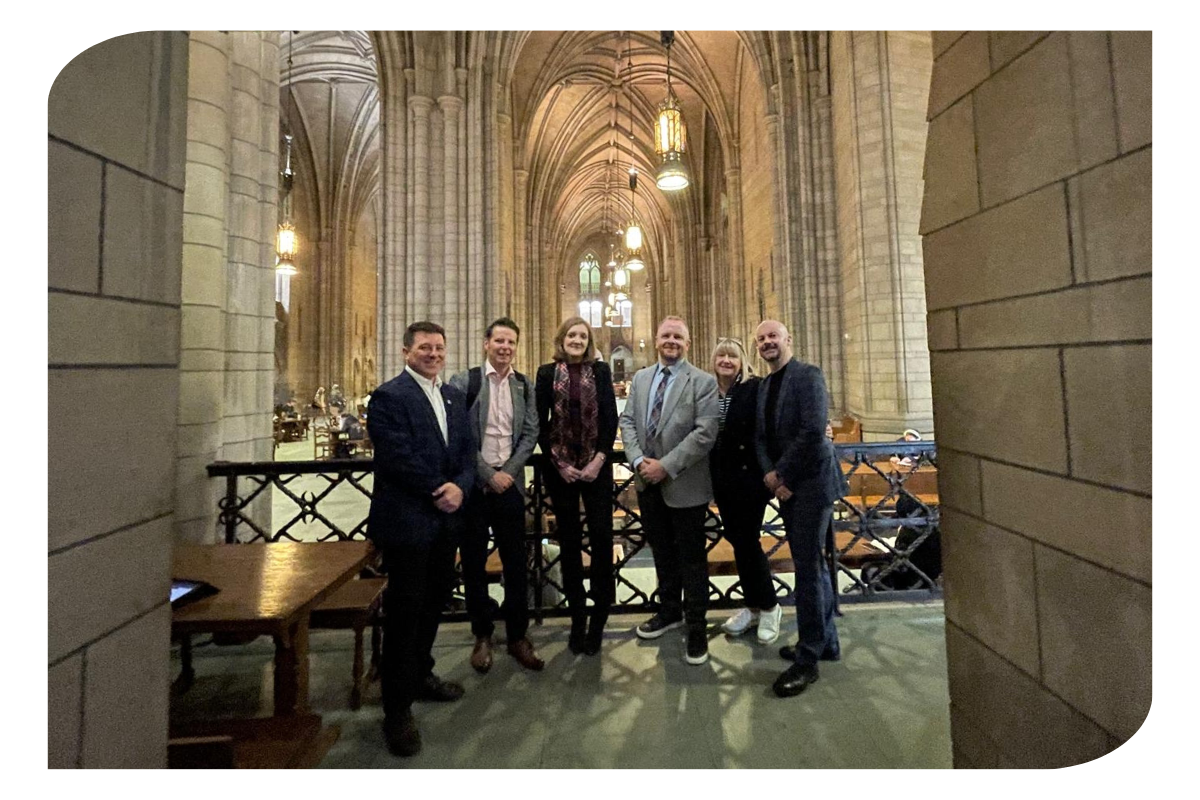
Our first day centred around the Oakland area, home to two of the most influential academic institutions in the United States. Beginning at the University of Pittsburgh, the setting itself, the Cathedral of Learning, was a reminder of the city’s deep academic heritage. This astonishing standout 42 storey building is known as the ‘world’s tallest schoolhouse’. It reaches 535 feet and was constructed between 1926 and 1938 in a Gothic style, and signifies that education never ends. The tower houses 29 ‘Nationality Rooms’ including the Scottish Nationality Room which bears tribute to creativity, ancient clans, education and the nobility of freedom with a portrait of Scotland’s immortal poet, Robert Burns, dominating the overmantel. Bay windows emblazoned with stained glass coats of arms represent the Universities of Glasgow, St Andrews, Aberdeen and Edinburgh.
But the discussion quickly moved to the future: how universities are acting as anchors within wider innovation ecosystems, connecting research, commercialisation and community impact. The roundtable format allowed for open, practical dialogue on where collaboration between Scotland and Pittsburgh could be accelerated.
That theme carried seamlessly into Carnegie Mellon University where we were met warmly by James H Garrett Jr, the Provost and Chief Academic Officer, and Keith Webster, the Scots-born Dean of University Libraries at CMU, one of the most prestigious universities in the US. CMU’s global reputation in robotics, AI and advanced technologies is well established, but what stood out was the accessibility of that expertise - how it is structured to engage with partners, support industry, and translate research into real-world application. The visit to the Posner Centre reinforced the importance of storytelling and heritage alongside innovation and understanding. We even got a chance to visit some historic and rare items including a first edition of 2 volumes of Adam Smith’s Wealth of Nations which was so apt given that we had Kenny Logue from the Adam Smith Business School at University of Glasgow on the mission, plus the first official printing of the US Bill of Rights and an original of Mary Shelley’s ‘Frankenstein’, where it takes on additional relevance here in the Posner Centre as it is shelved alongside works by Alan Turing and other pioneers of modern artificial intelligence.
The afternoon shifted to the cultural and civic fabric of the city. A visit to the Warhol Museum – another Carnegie funded project - provided a different and colourful lens on Pittsburgh’s identity - one that blends creativity, individuality and global cultural influence. That was followed by engagement with the Mayor’s Office and a wider discussion with Dan Gilman, the Chief of Staff for Pittsburgh Mayor Corey O’Connor on the city’s future direction with the alignment between public leadership and economic strategy here which is striking. There is clarity, consistency and a shared sense of purpose, and a lot of work going on to improve infrastructure and public realm work; the city is gearing up for hundreds of thousands of visitors in a week's time for the massive NFL Draft event, which is going to put the city on the global stage.
And then, in true Pittsburgh fashion, the day rounded off with an invite as guests to a ball game at PNC Park between The Pittsburgh Pirates and The Washington Nationals. It might seem like a step away from business, but these moments matter. Shared experiences - whether in a boardroom or a ballpark - are where relationships are often cemented. We seemed to be a lucky charm as the Pirates won convincingly which hasn’t happened so often apparently recently, and they literally knocked it out the park!
Day two brought that ecosystem into even sharper focus. At Hazelwood Green, we saw what large-scale, long-term regeneration looks like framed by the steel structure from a former steel mill when it is underpinned by vision and collaboration. The scale of the site is impressive, but more so is the intent behind it, creating a space where advanced manufacturing, robotics, life sciences and entrepreneurship co-exist and interact.
Sessions with RIDC and the ARM Institute highlighted how seriously Pittsburgh is taking the future of manufacturing, particularly the role of robotics and AI in reshaping industry. This isn’t theoretical; it’s being deployed, tested and scaled in real time.
The visit to the Roundhouse and the wider Hazelwood campus demonstrated how physical spaces can be designed to foster collaboration - bringing startups, researchers and established organisations together in a way that accelerates innovation. We closed the programme in Robotics Row, where the density of activity in AI, robotics and advanced engineering is remarkable. What stands out here is not just the concentration of companies, but the connectivity between them, supported by organisations like the Pittsburgh Robotics Network and Innovation Works.
Across both days, the consistent takeaway is this: Pittsburgh has built an ecosystem, not just a collection of assets. There are clear parallels for Glasgow, particularly in how we connect our universities, industry strengths and public sector leadership. The opportunity now is to translate these insights into tangible partnerships and collaborations that benefit both sides, and we’re already working on some practical next steps and follow ups with partners on both sides of the Atlantic to support our members and champion Glasgow. It’s been a truly inspiring Tartan Week I think for us all and it’s time to build action and outputs on to the momentum we’ve generated.